
What Your Thesis Supervisor Really Notices in Month One
Your supervisor forms lasting impressions about your thesis potential within the first 30 days—and these initial judgments can make or break your entire academic journey. While you’re focused on diving into research and getting your bearings, your supervisor is quietly evaluating everything from your communication style to your organizational approach, building a mental profile that will influence how they support you for months to come.
Most students unknowingly sabotage their early supervisor-student relationship management through common missteps that seem minor but send powerful signals about their future potential. The stakes are higher than you might think: research from the UK’s Council for Graduate Education shows that students who establish strong supervisor relationships within the first month are 40% more likely to complete their thesis on time and report significantly higher satisfaction with their academic experience.

This article reveals the specific behaviors and signals supervisors notice during those crucial first 30 days, giving you the roadmap to build a foundation that accelerates your thesis success. We’ll explore the hidden evaluation criteria supervisors use, decode their real expectations, and provide actionable strategies for mastering your month-one approach across three critical areas: communication patterns, organizational signals, and professional behaviors.
Why Month One Matters More Than You Think
The psychology behind supervisor impressions runs deeper than simple first impressions. Dr. Susan Phillips, a leading researcher in graduate education at the University of Toronto, explains that supervisors unconsciously apply what psychologists call the “halo effect” during initial interactions: positive early signals create a favorable lens through which all future work is viewed, while negative impressions require significant effort to overcome.
Effective early supervisor-student relationship management directly impacts three critical success factors: feedback quality, response times, and access to opportunities. Supervisors who view students as organized and professional tend to provide more detailed feedback, respond to emails within 24-48 hours rather than weeks, and actively recommend students for conferences, publications, and networking opportunities.
The disconnect between student assumptions and supervisor expectations creates most month-one problems. Students often assume supervisors want to see immediate research progress, when supervisors are actually evaluating whether students can manage a long-term project independently. While students worry about having the “perfect” research question, supervisors care more about seeing systematic thinking and realistic planning approaches.

Hidden evaluation criteria supervisors use include assessing your emotional intelligence through how you handle uncertainty, your project management potential based on how you structure initial conversations, and your coachability through how you respond to their guidance. These unconscious assessments happen rapidly—often within the first three meetings—and significantly influence the supervisor’s investment in your success.
“The students who thrive are those who treat month one as a professional onboarding process, not an extended orientation period.”
Statistics reinforce this reality: a 2023 study of 1,200 doctoral students across European universities found that 78% of successful thesis completions correlated with structured relationship establishment in the first month, while students who struggled with completion often reported feeling disconnected from their supervisors from the very beginning.
The Shift Toward Structured Early Engagement
Universities worldwide are recognizing the critical importance of month-one relationship building and implementing systematic approaches to improve outcomes. The growing emphasis on supervision contracts—formal documents outlining expectations, communication protocols, and milestone schedules—reflects this trend, with over 60% of UK universities now mandating these agreements by week three or four.
Supervisor training programs increasingly focus on identifying specific organizational signals early in the relationship. The National Association of Graduate-Professional Students reports that modern supervisor training emphasizes recognizing students who demonstrate systematic approaches, clear communication patterns, and realistic self-assessment abilities as key indicators of thesis success potential.
The rise of “thesis starter methodology” represents a significant shift in supervisor expectations. Rather than the traditional “explore and figure it out” approach, supervisors now expect students to arrive with structured planning frameworks. This connects directly to common thesis planning mistakes—particularly treating supervisors like mind readers who should instinctively understand your needs and timeline without explicit communication.
COVID-19’s impact on remote supervision has intensified the focus on clear communication from day one. When face-to-face interaction is limited, supervisors rely heavily on written communication and digital organization to assess student potential. This has elevated the importance of email professionalism, structured document sharing, and proactive milestone reporting as relationship-building tools.
The convergence of these trends means that successful early supervisor-student relationship management now requires more intentional strategy than ever before. Students who adapt to these evolving expectations gain significant advantages in building productive, supportive academic relationships.
What Supervisors Actually Notice (And Judge) in Month One
Communication Patterns That Signal Success
Your email communications reveal more about your potential than any initial research draft. Smart supervisors pay attention to what professionals call the “Tuesday 10am timing principle”—students who send important communications during business hours on weekdays signal respect for professional boundaries and systematic work habits, while weekend or late-night emails may suggest poor time management or anxiety-driven approaches.
The way you frame questions and requests demonstrates your intellectual maturity. High-potential students ask specific, contextual questions like “I’ve researched X and Y approaches to this problem, but I’m struggling to understand how Z factor influences the methodology—could we discuss this in our next meeting?” rather than vague requests like “I’m confused about my methodology.” This specificity shows independent thinking and research effort before seeking guidance.
Response time to supervisor communications sends powerful signals about your priorities and organizational systems. Students who acknowledge emails within 24 hours, even if they need more time to provide substantive responses, demonstrate respect and professional communication habits. Those who disappear for days or weeks without explanation signal potential reliability issues that concern supervisors planning long-term collaboration.
Professional email structure matters significantly. Effective students use clear subject lines, provide context for their questions, specify deadlines when requesting feedback, and include brief summaries of their progress. These habits indicate systematic thinking and consideration for the supervisor’s time—qualities essential for successful thesis completion. For deeper insights on optimizing these communication patterns, managing supervisor relationships for faster thesis feedback provides specific templates and timing strategies.
Organizational Signals Supervisors Evaluate
Whether you arrive with a structured plan reveals your project management potential immediately. Supervisors notice students who come prepared with preliminary timelines, milestone breakdowns, and resource requirements versus those who expect the supervisor to provide all structure. The difference signals whether you’ll need micromanagement or can work independently—a crucial factor in supervisor investment decisions.
Your approach to deadline management and micro-milestone setting demonstrates long-term thinking capabilities. Students who propose realistic weekly or bi-weekly check-ins with specific deliverables show understanding of thesis complexity and systematic progress monitoring. Supervisors value this because it reduces their management burden while ensuring consistent project advancement.
How you chunk and present work follows what experts call the “10-15 page submission rule”—breaking complex material into digestible sections that facilitate meaningful feedback. Students who submit focused, well-organized segments with specific questions receive better guidance than those who dump entire chapters without context. This organization suggests you understand the iterative nature of academic writing and value quality feedback over quantity.
The structured planning approach becomes even more powerful when students demonstrate familiarity with established methodologies. The thesis planning workshop methodology offers a four-phase framework that many supervisors recognize and appreciate, particularly Phase 1’s topic alignment process and Phase 3’s backward planning from defense date.
Professional Behaviors That Build Trust
Resource audit demonstrations show supervisors you’re prepared for independent research. Students who arrive with preliminary bibliographies, database access confirmations, and methodology resource lists signal serious academic preparation. This preparation suggests you won’t constantly need hand-holding for basic research tasks, freeing the supervisor to focus on higher-level guidance and intellectual development.
Realistic timeline proposals that incorporate the “2x rule”—doubling your initial time estimates for most thesis tasks—demonstrate maturity and self-awareness. Supervisors appreciate students who acknowledge the complexity of academic work rather than presenting overly optimistic schedules that inevitably require revision. This realism builds trust in your planning capabilities and reduces supervisor stress about unrealistic expectations.
How you handle feedback and incorporate suggestions provides immediate insight into your coachability. Students who ask clarifying questions about feedback, implement suggested changes thoughtfully, and report back on their application of guidance demonstrate the learning orientation essential for thesis success. Supervisors invest more heavily in students who clearly benefit from their mentorship.
Your approach to meeting preparation and agenda-setting reflects professional development potential. Students who send agenda items in advance, come prepared with specific questions, and take notes during discussions show they value the supervisor’s time and expertise. These behaviors suggest you understand the mentorship relationship’s professional nature, not just its academic requirements.
Red Flags That Damage Early Relationships
“Draft dumps” without context or specific feedback requests frustrate supervisors immensely. When students submit large documents with vague requests like “please review,” they’re essentially asking supervisors to do their critical thinking for them. This approach signals dependence rather than collaboration and often results in generic feedback that doesn’t advance the work meaningfully.
Unrealistic expectations about response times reflect misunderstanding of academic workloads. Students who expect same-day responses to complex questions or become anxious when supervisors take a week to review substantial work demonstrate poor boundary awareness. Supervisors notice this impatience and may interpret it as self-centeredness or unrealistic professional expectations.
Lack of independent problem-solving attempts before reaching out suggests over-reliance on supervision. Supervisors expect students to research solutions, consult relevant literature, and attempt multiple approaches before seeking guidance. Students who immediately email about every challenge appear unprepared for independent research and may be perceived as requiring excessive management attention.
Poor boundary respect regarding supervisor availability damages relationships quickly. This includes expecting responses during vacations, calling personal phone numbers for non-emergencies, or scheduling meetings outside stated office hours without permission. These behaviors suggest poor professional judgment and disrespect for work-life boundaries. Understanding and avoiding these issues early prevents relationship damage that can take months to repair, as detailed in thesis starter mistakes and planning.
The Evolution of Supervisor Expectations
Digital collaboration tools are rapidly becoming standard expectations in supervisor-student relationships. Modern supervisors increasingly expect students to be proficient with project management platforms like Notion, Trello, or specialized academic tools that enable transparent progress tracking and efficient collaboration. Students who proactively suggest and implement these systems demonstrate technological adaptability and professional organization skills that supervisors highly value.

The growing expectation for students to demonstrate research methodology awareness early reflects the increasing complexity and interdisciplinary nature of modern academic research. Supervisors now look for students who can articulate their philosophical assumptions, justify their methodological choices, and understand the limitations of their approach within the first month. This shift requires students to engage more deeply with methodology literature before beginning substantial research work.
AI tools are transforming thesis supervision dynamics in ways that will significantly impact early supervisor-student relationship management. Supervisors increasingly expect students to understand how to leverage AI responsibly for research efficiency while maintaining academic integrity. Students who can demonstrate sophisticated AI collaboration—using tools for initial literature reviews, citation management, and draft organization while clearly delineating human intellectual contribution—position themselves as forward-thinking researchers.
The prediction that supervision contracts will become standard practice across institutions by 2025 is supported by current adoption trends. These formal agreements will likely include digital collaboration expectations, AI usage policies, and more structured milestone requirements. Students who proactively suggest contract development demonstrate professional maturity and relationship investment that supervisors notice and appreciate.
Looking forward, early supervisor-student relationship management skills will become increasingly valuable in academic careers beyond the thesis. As academic collaboration becomes more global and digital, the ability to quickly establish trust, demonstrate competence, and maintain professional relationships remotely will distinguish successful researchers. Master’s and doctoral students who develop these skills early gain advantages that extend throughout their academic and professional development.
“By 2030, the most successful graduate students will be those who can seamlessly blend traditional academic mentorship with digital collaboration and AI-assisted research, while maintaining the human connection and intellectual rigor that define quality supervision relationships.”
Master Your Month One Strategy
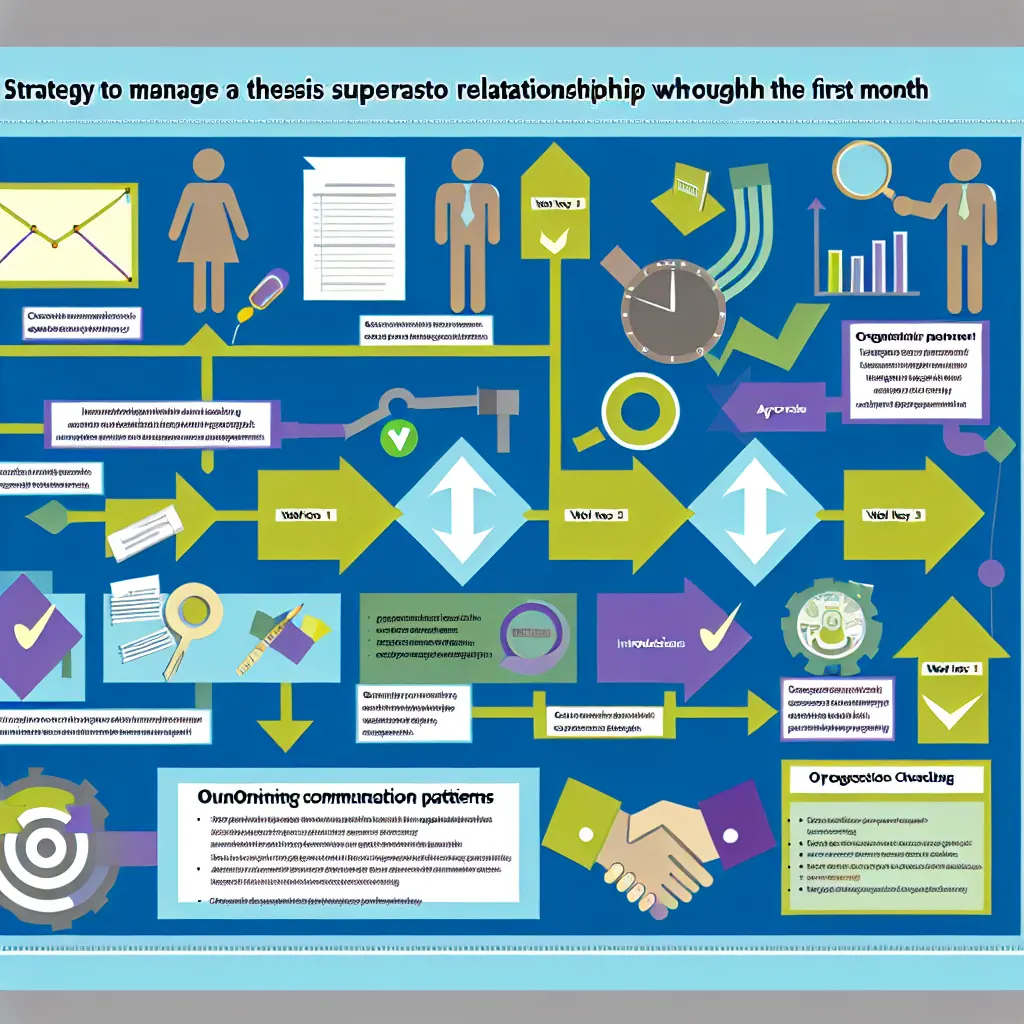
Transform your supervisor relationship with this practical Month One Supervisor Relationship Audit. In Week 1, establish professional communication by sending a structured introduction email outlining your background, thesis interests, and initial questions, while setting up a consistent communication schedule that respects their preferred contact methods and response times.
During Week 2, demonstrate organizational readiness by preparing a preliminary thesis timeline with realistic milestones, conducting a resource audit to identify available databases and literature access, and scheduling your first formal meeting with a prepared agenda including specific discussion points and questions.
Week 3-4 should focus on expectation alignment through proposing a supervision contract that outlines communication preferences, feedback expectations, meeting frequency, and emergency contact protocols. Present your structured thesis planning approach, potentially incorporating established methodologies, and implement a progress tracking system that provides transparent updates on your advancement.
Ready to Accelerate Your Thesis Success?
Modern academic success requires sophisticated tools and systematic approaches that go beyond traditional student guidance. The comprehensive planning frameworks, communication templates, and relationship management strategies you need are now available through advanced academic platforms designed specifically for thesis success.
Take action today: Visit app.tesify.io to access our complete Thesis Planning Workshop methodology and professionally-designed supervisor communication templates that ensure you make the right first impression and maintain productive relationships throughout your thesis journey.
Don’t leave your thesis success to chance—join thousands of students who are already using structured approaches to build exceptional supervisor relationships and complete their theses faster. Subscribe to our thesis success newsletter for weekly supervisor relationship tips, planning strategies, and exclusive insights from academic mentorship experts.
Student Success Story: “Using structured supervisor communication approaches transformed my thesis experience. Within the first month, my advisor was responding to emails within hours instead of days, and our meetings became incredibly productive. The planning templates and relationship strategies made all the difference in establishing trust and getting the support I needed.”
— Sarah K., PhD Candidate, University of Cambridge




Leave a Reply